
Corruption Is Making Us All Sick
The Pitch: Economic Update for Thursday, July 23rd, 2026

Friends,
This week we’re exploring the unwelcome return of tariffs, another economic signal warning that our economy is fractured between the haves and have-nots, and why the worst SNAP cuts in three decades couldn’t have arrived at a worse time.
I also want to talk about the public health crisis that’s been making headlines this week, but first we have to step back and talk about corruption. I’ve been writing with some regularity about corruption in the federal government, and last week another case of a federal employee allegedly profiting from their taxpayer-funded job came to light.
Bobby Allyn at NPR reports, “Federal regulators are in settlement talks with President Trump’s longtime teleprompter operator, who is alleged to have made nearly $100,000 on the prediction market site Kalshi.” Allyn explains that the teleprompter operator “is suspected of profiting off of his access to the president’s prepared remarks on a type of betting on Kalshi known as ‘mention markets,’ where people wager on words and expressions the president will or will not say during public events.”
Admittedly, when we’re talking about paydays like the president and his family making a billion dollars from cryptocurrency, $100,000 is a drop in the bucket. But that’s the thing about corruption: Any exterminator will tell you that if you spot a single cockroach on a kitchen counter, there are almost certainly dozens more lurking behind the walls. For every one instance of self-serving in the White House that is reported on, there are likely to be ten more people behind the scenes enriching themselves at taxpayer expense. Corruption engenders distrust, and when distrust spreads widely enough through a system, people begin to doubt the trustworthiness of the entire system.
As you know, the Food and Drug Administration is currently struggling to contain an outbreak of the parasite Cyclospora, which can be found on fruits and vegetables and which causes severe digestive distress, to put it politely. As of Monday, health agencies across 27 states have reported more than 6000 cases of people sickened by Cyclospora. The FDA reported that some test results indicated the likely culprit was shredded iceberg lettuce from Taylor Farms, a major producer of fruits and vegetables that both distributes to restaurants and sells directly to consumers through grocery stores.
On Sunday, the FDA issued a rare retraction of those claims, writing “FDA laboratory experts re-reviewed the sample results and have concluded that the finding does not represent true amplification and should be considered a false positive.”
The New York Times reports that the FDA’s retraction “followed days of confusion after Taylor Farms voluntarily recalled iceberg lettuce from 27 states, but did not offer more information about how people would be able to tell whether they had bought the contaminated product.”
“The F.D.A.’s retraction of the test result only enhanced uncertainty about what’s to come in the largest recorded cyclospora outbreak in U.S. history,” the Times added.
As I write these words, Americans are still confused and alarmed about the Cyclospora outbreak, and many people are avoiding raw fruits and vegetables altogether until reported cases die down. Two days ago, Health and Human Services Secretary Robert F. Kennedy Jr. said the outbreak was “under control,” but that claim hasn’t seemed to resolve the panic.
On his Patreon, reporter Matthew Cortland pulled together a few important facts to explain why a fairly typical public health incident has transformed into a widespread panic:
First, he notes, the Biden administration passed a “law called the ‘Food Traceability Rule,’” which was “designed to make tracing contaminated food easier.” The law “was supposed to go into effect on January 20, 2026.”
One year before the bill was to be enacted into law, Cortland writes, “Taylor Foods started paying Sidley Austin to lobby on ‘regulation of food safety.’”
Less than three months after Taylor Foods hired the lobbying firm, on March 20, 2025, Cortland notes that the “FDA announced they were pushing back the implementation of the ‘Food Traceability Rule” by 30 months.’
Six days after the Trump administration announced it had delayed the “Food Traceability Rule,” Cortland notes that “Taylor Fresh Foods Inc contributed $1,000,000 to MAGA Inc, a Trump-aligned super PAC.”
We can’t look at these facts and determine beyond a reasonable doubt that Taylor Fresh paid Donald Trump’s political machine to kill the FDA’s ability to trace foodborne outbreaks like the one the nation is facing right now. But because there are so many stories of corruption in this administration—because even the guy who runs the teleprompter was apparently using insider knowledge to make money on the side—we see scandals everywhere we look. In this environment, the facts that Cortland shared make it easy to come to the conclusion that the federal government is protecting Taylor Foods in exchange for political donations.
A culture of corruption in politics doesn’t just enrich the politicians who are busy getting their beaks wet—it also advances their political positions by inspiring fear and mistrust in the government.
If people believe that government is captured by selfish, self-interested crooks who are only looking out for themselves, they’ll stop trusting government to handle tax dollars responsibly and to provide investments that benefit the American people. That kind of environment is toxic and dangerous, but it’s also favorable to trickle-downers who can use that growing distrust in government to campaign for tax cuts for the rich and deregulation for the powerful.
The Taylor Farms debacle is a great example of why it’s important for progressive politicians to run on a strong anti-corruption campaign. Senator Elizabeth Warren has written an excellent anti-corruption bill that would be a good place for any candidate to start. Among other things, the bill imposes limits on the politician-to-lobbyist pipeline, breaks up close relationships between federal employees and corporations, and requires the disclosure of any potential conflicts of interest with strict repercussions for any violations.
We only have a short time to undo this damage before it becomes permanent. If a large number of self-serving politicians are quickly arrested and convicted for profiting on the people’s dime, our next crop of leaders can repair this growing distrust between the people and their government, and government can get back to the necessary work of informing and protecting the public, while also punishing the big corporations that play fast and loose with public health.
The Latest Economic News and Updates
Tariffs Are Back
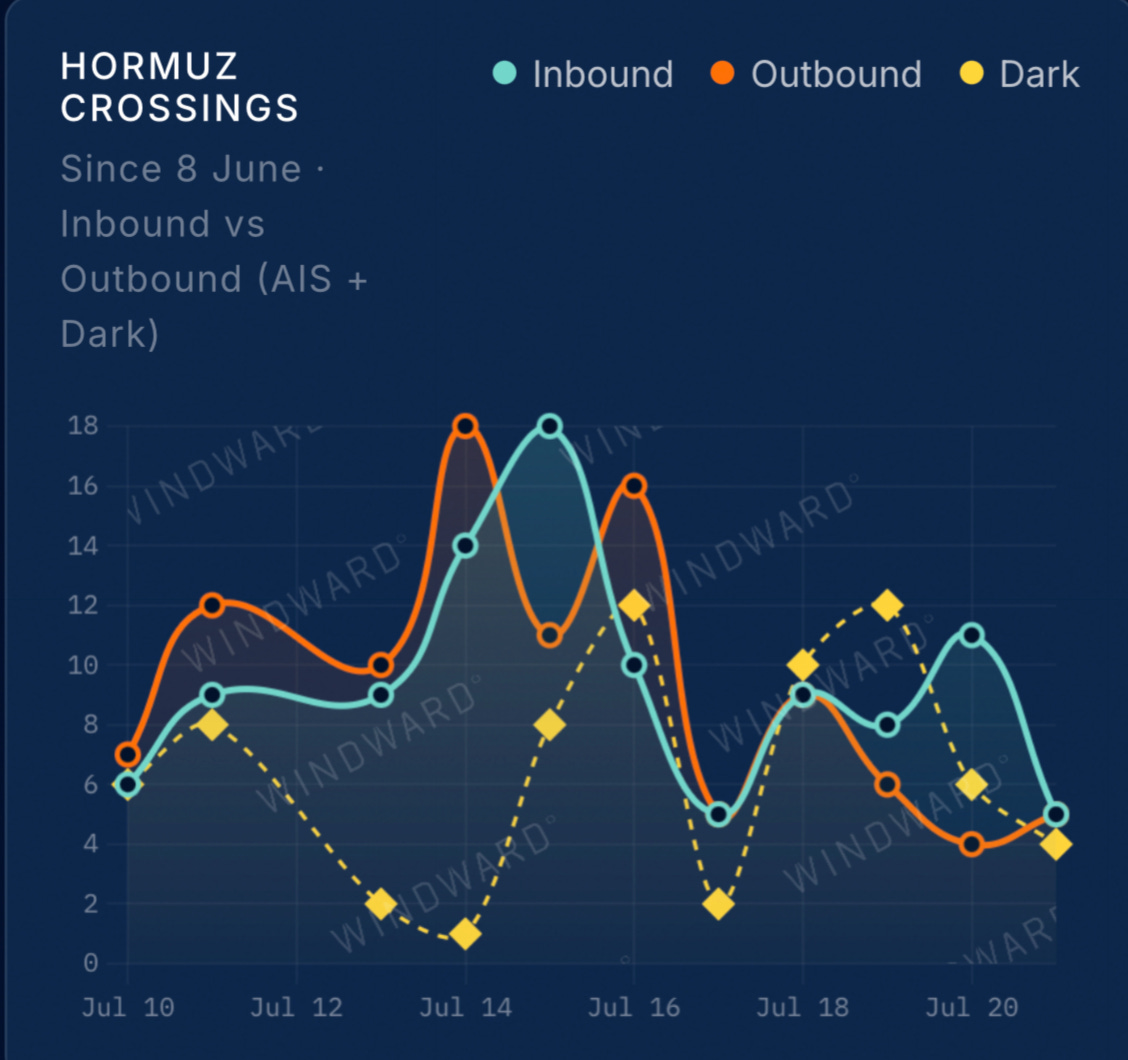
Last week, we wrote about the lower-than-expected inflation report, which suggested that the ceasefire in Iran had inspired a temporary reprieve from the rising prices Americans have been struggling with for the past four years. In the days since that inflation report, the war on Iran has restarted, and shipping traffic through the Strait of Hormuz has essentially dropped back to zero:
If those pressures weren’t enough, this week President Trump decided to reignite his campaign of high tariffs on imported goods—this time on goods from Canada.
“The Trump administration announced Monday it will hit Canada with a 50% tariff on many goods imported into the United States,” reports Michelle Stoddart at ABC News.
“The list of goods covered by the new duties is very wide-ranging, from dairy products, alcohol and alcohol-related products to some food products,” Stoddart continues. “The tariffs also cover construction materials, clothing, furniture and technology, among other things.”
That wasn’t the only set of high tariffs imposed by the Trump administration this week. Mary Cunningham writes at CBS News, “Imported generic drugs could face tariffs of up to 100% beginning in 2028 under a plan announced Tuesday by President Trump, who said the measure is intended to push manufacturers to move production to the U.S.”
The idea that any Big Pharma company could reshore generic drug manufacturing in the United States in a span of roughly two years is highly unrealistic, to say the least. As a reminder, America has lost over 100,000 manufacturing jobs in the first year of the Trump administration after several years of manufacturing growth.
This is the first major spate of tariffs imposed by Trump since the Supreme Court ruled that the first round of tariffs was illegal and required the Trump administration to reimburse businesses that paid the tariffs.
“According to the budget data, the US has paid out $81 [billion] in tariff refunds so far this fiscal year, which started in October 2025, compared with $5bn during the same period last year,” Laura Almeida at the Guardian reported.
There are likely more tariffs on the way. “The latest proposal could affect leading partners including the UK, Japan, India, Taiwan and China, and would enable Trump to skirt previous court-imposed limits on his protectionist agenda,” Almeida writes. “The new tariff rates are expected to be between 10% and 12.5%. The US has also threatened to impose fresh levies of 25% on Brazil.”
“Last month Trump also threatened a 100% tariff on European countries, including the UK, that pursue a tax on the biggest US tech companies,” Almeida adds.
As we saw during the first round of tariffs last year, these tariffs are nothing more than an additional sales tax on American consumers. The Senate’s Joint Economic Committee determined that the average American family paid more than $1700 in tariffs between February of 2025 and January of 2026, totaling more than $231 billion in tariffs over the course of those eleven months.
While big corporations are enjoying the windfalls of tens of billions of dollars in tariff refunds, the working Americans who actually paid hundreds of billions of dollars in tariffs last year will not see a single penny of that payout. Instead, it looks like they’re being rewarded with even more tariffs this year.
Even though Americans have seen prices rise virtually everywhere for the last four years, the fact remains that they are still spending money. “Retail sales rose 0.2% in June, the fifth straight monthly increase, after May was revised up to a robust 1%,” writes Courtenay Brown at Axios.
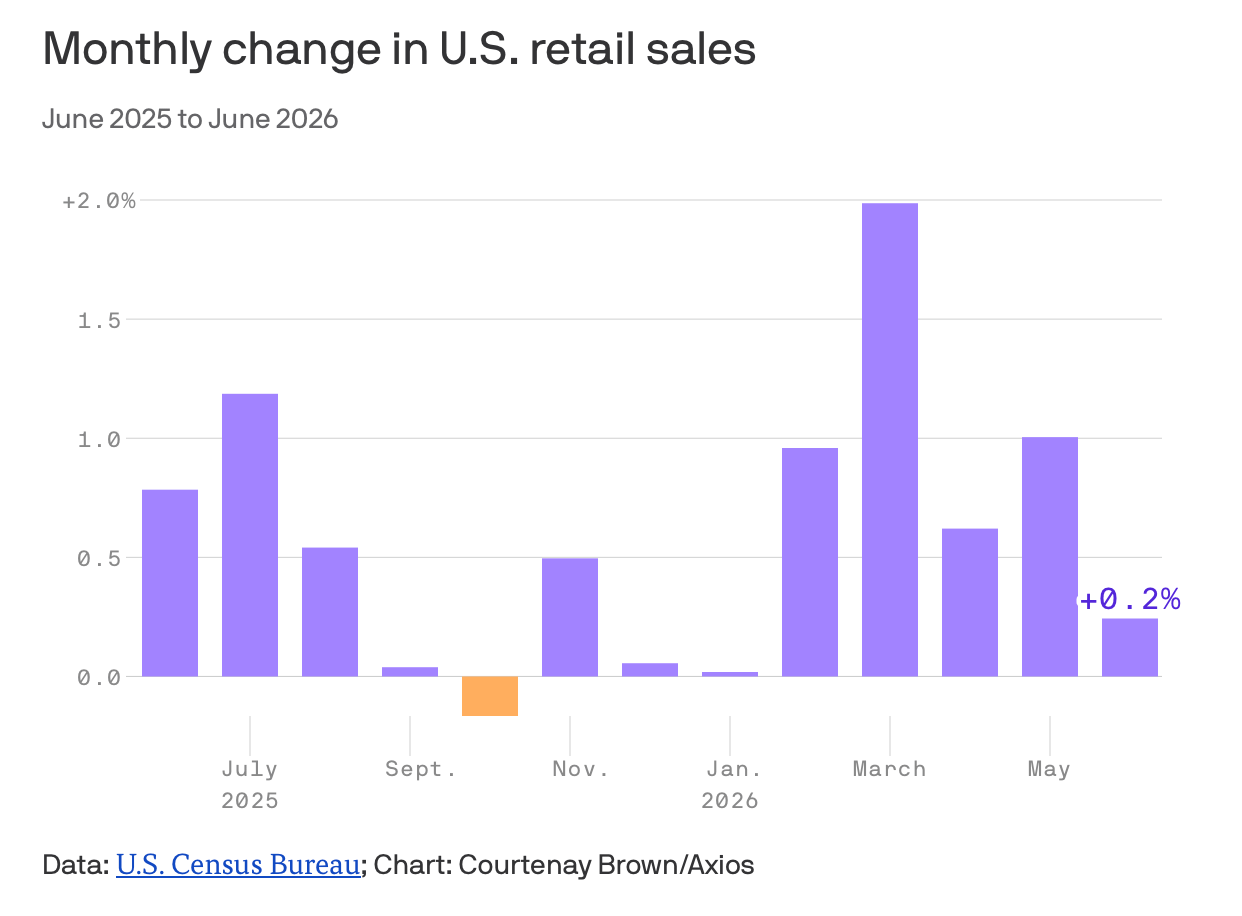
The sales figures weren’t all strong. “Grocery sales fell 0.4%, while spending at clothing stores declined 0.3% and health and personal care retail shopping dropped 0.8% from May,” Brown reports. This could be a continuing sign of the K-shaped economy, with wealthy consumers in the top quintile of the economy holding up retail sales while everyone else struggles to pay their weekly grocery bills.
For Black Enterprise, Sidnee Michelle writes, “The Urban Institute found that 63% of working-age adults used a credit card to buy groceries during the previous year.” That’s a seven percent increase in Americans using credit to buy groceries over last year.
Michelle continues, “While most paid their balances in full, 19.6% carried a balance while making at least the minimum payment, and 8.7% said they did not consistently make the minimum payment.”
“The survey also found that nearly 10% of adults used buy-now, pay-later loans to purchase groceries. Among those borrowers, 34.8% missed at least one payment,” she adds. “About 20% of respondents also reported using savings intended for emergencies or other long-term financial goals to pay for groceries.”
This is a blinking red light for the American economy. Food is an essential expense, and a growing number of Americans are finding it difficult to pay those bills. And in the closing of this email, we’ll look at the unfortunate fact that millions of Americans are simultaneously being wiped off the rolls of food assistance programs around the country.
The massive income inequality between the wealthiest ten percent and the rest of the economy is obfuscating the pain that ordinary Americans are feeling—and if the Trump administration continues its war on Iran and campaign of tariffs, that pain is only going to get worse in the next year.
Our Fractured Economy Favors Investors Over Workers
“During the Biden administration, federal incentives were put in place to push companies into developing clean energy technologies. Hundreds of projects were put in motion, costing billions of dollars, to do just that,” explains Nico DeMattia at Inside EVs.
Then, “the Trump administration reversed those Biden-era policies, causing the stalling or cancellation of 223 different projects, totaling $82.9 billion in lost investments.”
That has resulted in a disaster for working Americans. DiMattia explains that “111,765 jobs were lost as a result of these project cancellations.”
The Trump administration has also made it harder for just over 3,000 clean-energy companies to access tax credits put in place by previous administrations to encourage alternative energy sources. Those lost tax credits could put “$695.2 billion [in clean-energy investments] at risk, threatening almost 1.2 million jobs.”
This is another kick in the teeth for American workers, even as the elite shareholder class currently enjoys record profits from Big Oil companies thanks to the skyrocketing price of gas.
For the American Prospect, Harold Meyerson explains the fracture in the American economy in language that’s about as succinct as I’ve seen: “If there’s a problem with the American economy, it’s only because some people have to work for a living,” Meyerson writes.
“Income from investment—the primary source of income for roughly 1 percent of Americans—is soaring,” he explains. “The remaining 99 percent, who depend primarily on income from their work, are the laggards grousing about prices and necessities that may be out of reach.”
There are two things we need to do to repair this fracture between the elite investor class and hundreds of millions of working Americans. First, we need to rewrite the tax code to tax investment income at least as much as we tax work income. Second, we need to raise wages for all American workers so that they’re compensated for their productivity again, the way they were before the dawn of trickle-down economics in the early 1980s.
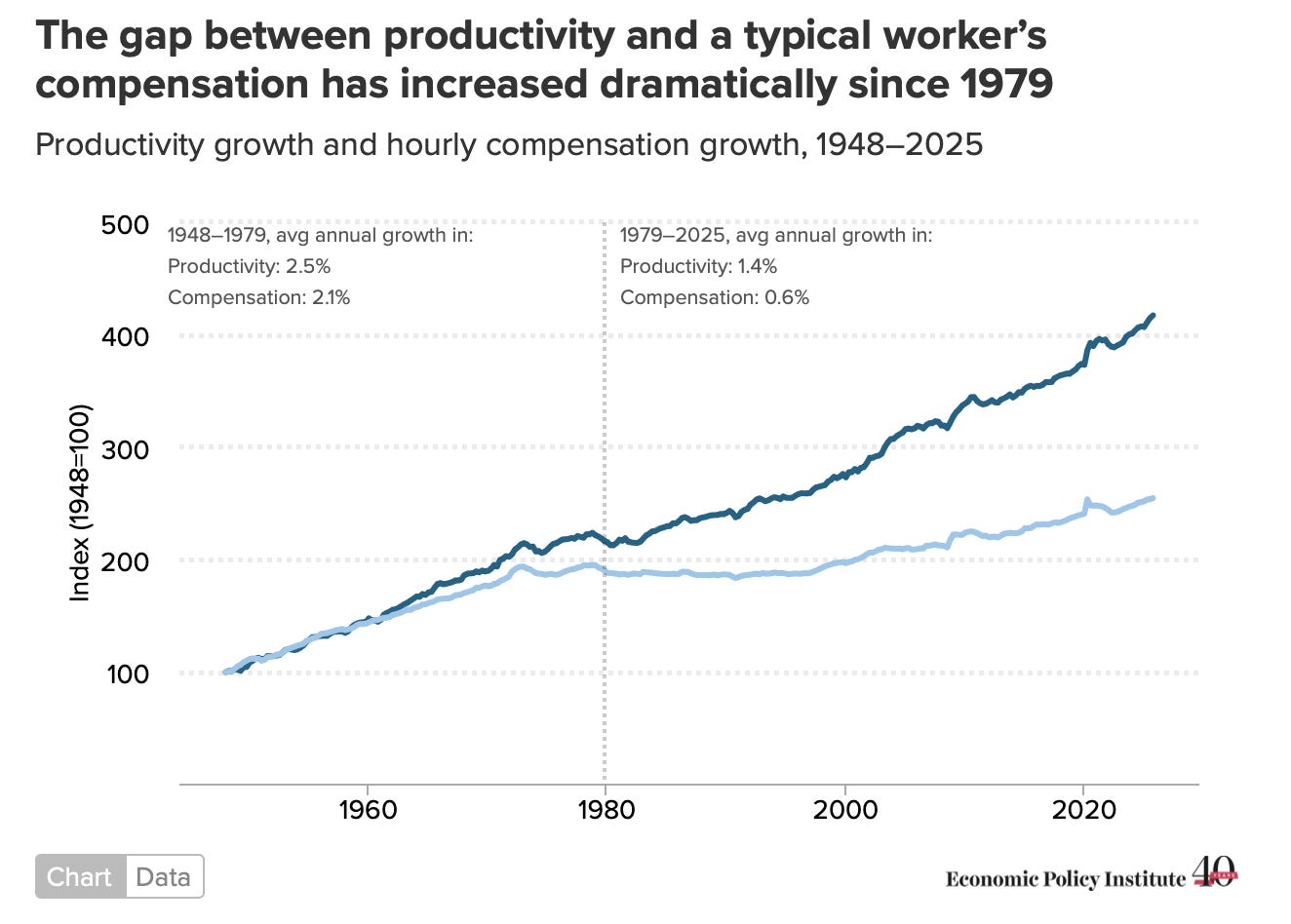
The Economic Policy Institute establishes one way to reinvest in American workers by proposing that we set a goal of tripling union membership in the United States of America. Doing so, they argue, would raise wages for the median worker by $7,700 annually, amounting to more than a quarter of a million dollars in additional pay over the course of a typical 35-year career. It would shift more than $1 trillion away from the wealthy few and into the pockets of working Americans, narrowing racial wage gaps and increasing the number of working-age people with health insurance by as much as 25%.
EPI suggests that lawmakers can meet that goal of tripling union membership by passing legislation including the PRO Act, which makes it easier for workers to organize workplaces, and guaranteeing the right to organize for all public-sector employees. Another intriguing policy from EPI: Any corporation whose CEO is compensated more than 100 times the average worker’s annual pay automatically enters into a collective bargaining agreement, in which workers can advocate for a greater share of the company’s profits.
Union membership isn’t the only solution to the problem of outsized wealth inequality, but EPI’s argument is a good one. When workers are compensated fairly for their labor, everyone benefits—unemployment benefits increase, public education improves, and more people vote. It’s no wonder why trickle-downers favor policies that kill high-paying clean-energy jobs and keep working Americans struggling to make ends meet: When everyone can participate in the economy, outcomes improve for everyone—not just a wealthy few at the top.
This Week in Trickle-Down
Early next month, Missouri voters could decide to eliminate the state’s personal income tax system. The Center on Budget and Policy Priorities warns that doing so would “ shift the responsibility for funding state services further onto workers, families, and seniors and away from wealthier taxpayers.”
This Week in Middle-Out
“On July 16, 2026, Sens. John Boozman (R-AR) and Kirsten Gillibrand (D-NY) introduced the More Paid Leave for More Americans Act to incentivize states to expand access and improve coordination of paid family leave benefits for workers,” reports the Bipartisan Policy Center.
Real-Time Economic Analysis from Civic Ventures
We at Civic Ventures have been talking about the economic paradigm shift that’s happening right now. Yesterday, Civic Ventures founder Nick Hanauer published a video explaining how, though it may not feel like it, we are living through a paradigm shift right now. The status quo is very invested in keeping our economy functioning the same way it has for the last 50 years, but the thing about new ways of thinking is that the truth always wins out in the end.
In this week’s episode of Pitchfork Economics, Nick and Goldy talk with economist Preston Mui about why productivity has become a policy choice that is divorced from wages, rather than a reflection of how successful a worker is at their job. The separation between productivity and wages is especially important right now, when technology threatens to increase productivity at an exponential rate even as paychecks stagnate.
Closing Thoughts
Earlier in this newsletter, I wrote that retail spending rose for the fifth consecutive month even as grocery sales declined—a likely sign that even though wealthy Americans are spending freely, working Americans are struggling to deal with the cumulative 33% grocery price increase since 2019. Bain & Company’s grocery sales analysis finds that the last five months have seen declines in grocery spending over the year before.
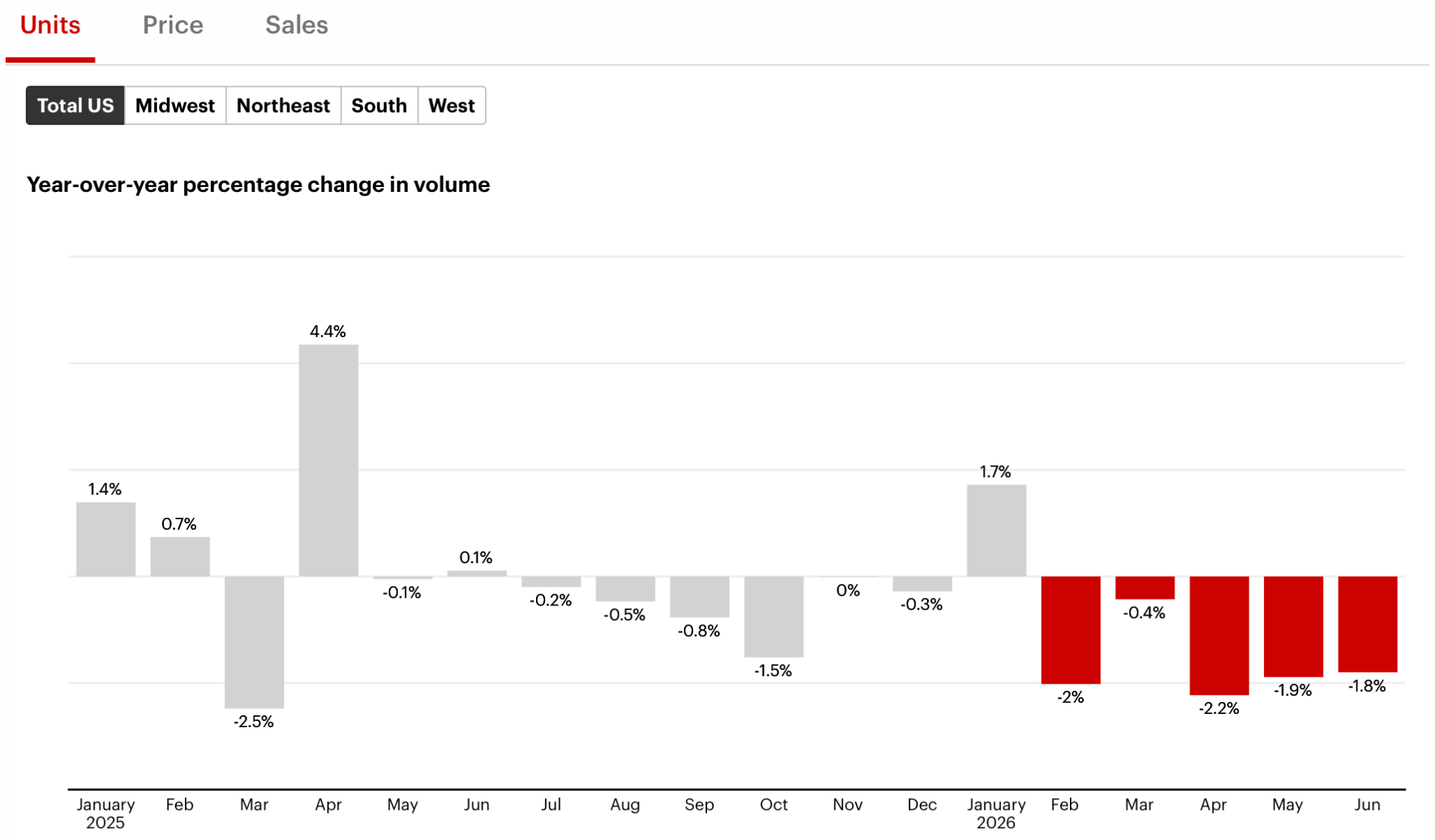
“Our analysis of NielsenIQ grocery data shows a trend in negative unit growth starting in mid-2025, masked by steady price increases. But since February 2026, units have stepped down sharply enough to pull sales lower across the US,” Bain notes in their report. “Prices are still climbing 2% to 3% year over year, roughly in line with food-at-home inflation, while units are down about 2% year over year in most months since February.”
Bain concludes, “Pricing growth and inflation can no longer hide that shoppers are buying fewer items.”
Survey data seems to back up Bain’s research: “80% of Americans say they’re still trying to spend less, and 28% are actively trying to cut back on groceries,” Bain reports. “Among those trimming their grocery bills, 56% are trading down to lower-priced brands, 49% are simply buying fewer items, and 44% are leaning harder on coupons and promotions.”
No matter how much groceries cost, and no matter how much paychecks have stagnated this year, human beings have to eat. So what happens when a growing number of Americans can no longer afford to pay for food? For most of the 20th century, the answer was that they would go on Supplemental Nutrition Assistance Program (SNAP, the program formerly known as food stamps) which would help feed struggling families until they finally got back on their feet again.
Last year, the Trump administration issued some draconian cuts to SNAP programs in order to fund a tiny sliver of the massive tax cuts it handed to the richest Americans. As a result, the Center on Budget and Policy Priorities reports that this year has seen the biggest drop in Americans on SNAP rolls in exactly three decades, since the Clinton administration pushed through a drastic program of neoliberal cuts to the social safety net in 1996.
In fact, according to USDA data, nearly five million Americans have stopped participating in SNAP programs over the last year—a decline of 11 percent. Every single state except Alaska has seen SNAP enrollment drop.
It gets worse: CBPP estimates that this year alone, one million children are no longer covered by SNAP. Since last June, that number may be as high as 1.5 million children.
These numbers haven’t declined because the circumstances of four million Americans have drastically improved over the past year. The labor market is still roughly the same as this time last year, and wages have been stagnant in 2026. The only significant economic factor that has changed for the entire nation in that time period is the Trump tax bill and its cuts to the social safety net.
To reiterate, groceries are now a third more expensive than they were seven years ago. In other words, $300 worth of groceries in 2019 now costs $400. Given that wages have flatlined this year, it’s safe to assume that many working American households are going hungry. And remember that SNAP also serves as revenue for grocery stores in many of America’s most impoverished rural areas, meaning that it’s not just the SNAP recipients who are likely to suffer now that SNAP funds aren’t circulating through local economies.
This is unsustainable, and it’s harmful to all Americans. I’ve written recently about the fact that childhood hunger can have negative impacts that last a lifetime. And adults who can’t access three solid meals a day are more likely to have accidents and be less productive on the job. It’s in everyone’s best interests to make sure that we’re investing in programs that feed people.
Now, when demand is rising along with grocery bills, the Trump administration’s austerity is making it even harder for people to access SNAP. In an economy like ours that works best when everyone can participate, those hunger pains hurt us all.
Be kind. Stay strong.
Zach