
We Need to Unrig the System
The Pitch: Economic Update for Thursday, July 9th, 2026

Friends,
This week, we’re looking at the absurd claims that rising grocery prices aren’t a cause for concern, the reasons behind a slump in factory construction, and why we should all support free and reduced-price school lunches.
But first, a new report from the Roosevelt Institute finds that its “analysis of data on Kalshi, now the largest prediction market in the United States, found that ordinary users of the platform have lost more than half a billion dollars from its launch in July 2021 to May 2026.”
The report adds, “when retail traders made money, it was mostly on a small number of the largest wagers.”
App-based prediction markets have exploded in popularity over the last two years, as technology finally caught up with a 2018 Supreme Court ruling that essentially deregulated sports gambling nationwide. Since then, users have lost hundreds of millions of dollars betting on sports, current events, and other outcomes that would have been unthinkable for the majority of the population a decade ago.
People who are tracking the massive explosion of income inequality in the US will not be surprised to hear that prediction markets have worked out in a very familiar way. Reports have found that “the vast majority of people participating in prediction markets (retail traders) lose money, with the profits being captured by an extremely small number—the top 0.1 to 1 percent—of sophisticated users.”
Gambling tends to trigger bravado in certain individuals—especially risk-prone young men—who believe that they can somehow beat the system and become part of that sophisticated top 0.1 percent. That’s why it’s important to note that the tiny percentage of people beating the odds on Kalshi and Polymarket “participate in these markets in ways that are entirely different from how the average user interacts with them.”
In other words, they’re not just better at picking bets—they’re spreading their bets wider and investing larger amounts of money on smaller-risk bets to steadily reap rewards in a way that working Americans simply can’t afford.
The systems are rigged against participants with the least money to spend and in favor of the wealthiest people who can bend the rules in their favor. (And as I’ve noted in the past, these deregulated gambling industries are also rife with insider trading.)
Everywhere you look in the headlines, you’ll find someone rigging the game in their favor and reaping the rewards. Last week, President Trump disclosed that he had pocketed over $1 billion from various cryptocurrency investments last year alone. David Goldman reports for CNN that when Trump announced a crypto venture called $TRUMP, a so-called “memecoin” for his followers to invest in, he “earned transaction fees each time $TRUMP was bought or sold,” and he also likely sold his shares of the memecoin at strategic points before the value crashed.
“$TRUMP was an instant success, catapulting to a $15 billion market valuation, according to CoinMarketCap. It’s now worth just $400 million – a 97% implosion,” Goldman reports. To be clear, that’s a direct transfer of wealth from Trump supporters who are working Americans to an elite class of insiders who somehow knew exactly when the value of $TRUMP would drop and pulled their investments at their peak.
This week, the New York Times reported that “Nearly 1 million people who bought President Trump’s memecoin have lost money through the end of June.” Their losses are estimated at $3.81 billion.
It’s likely that only a handful of extremely wealthy individuals, including President Trump himself, took home a lion’s share of that $3.81 billion. Forbes spoke with several Trump supporters who lost significant portions of their wealth in the $TRUMP crash, including one man whose $205,000 investment in $TRUMP is now worth roughly $30,000.
Looking at these two stories, is there any wonder why the American people are feeling discouraged about the economy and politics? As prices keep rising faster than wages and unregulated financial systems are fleecing working people in favor of a handful of elites who are in on the scam, you can expect to see unrest and dissatisfaction with the system continue to grow.
And it’s not just Republicans who appear to be benefiting from these systems. We’ve talked before about how Nancy Pelosi’s stock portfolio has skyrocketed far above the return that average Americans see from their investments. And for The American Prospect, Fletcher Calcagno and Dylan Gyauch-Lewis write that New York Senator Kirsten Gillibrand’s 22-year-old son recently saw the kind of success that virtually no recent college graduate could fathom.
“Theodore Gillibrand, son of Sen. Kirsten Gillibrand (D-NY), had received a $30 million round of investment for his company, American Perpetuals Exchange Corporation (APEC),” they write. “The funding round valued APEC at $300 million and was led by Lux Capital, a venture capital firm whose other investments include the Peter Thiel–backed Anduril Industries and Erebor Bank.”
Gillibrand’s son’s venture combines the unregulated thrills of prediction markets with the worst of crypto’s volatile swings in wealth. The Prospect explains, “Rather than betting on the price of crypto going up or down, perps traded on APEC will allow users to speculate over the value of a stock increasing or decreasing without ever taking ownership.” So the fund isn’t trading actual crypto investments; it’s taking bets on how those investments will pan out.
It’s possible that Gillibrand’s son is an exceptionally precocious financial genius who formulated this idea entirely on his own. But a U.S. Senator’s son heading directly from his college graduation to a $300 million valuation of a company is enough to continue the perception of corruption that is eroding the economic faith of working Americans that the system is working. We’ve come to expect to see people cashing in for themselves and their families at everyone else’s expense, and that’s bad news for the whole system.
The good news is that we know how to combat this kind of corruption. The late 19th century saw a progressive anti-corruption slate that brought the first Gilded Age to an end, and for most of the postwar 20th century, corruption laws worked to prevent the worst kind of pillaging and looting. We just need to reinstate the protections that worked and update a new slate of policies for the 21st century to prevent the modern-day Gilded Age from getting even worse.
It’s easy to imagine a slate of policies encouraging maximum transparency and accountability in financial transactions and smart regulations that rein in the worst impulses of prediction markets and crypto profiteers. We also need to hold anyone accountable who uses inside information or unfair rules to bilk working people out of their fortunes with jail time.
Those three goals—transparency, regulation, and consequences—are all that we need to undo the excesses we’re seeing in the headlines today. That needs to be our message to Americans who are giving up hope when they see a tiny share of the most shameless people extracting wealth from millions of working people: We can fight corruption. We’ve done it before, and we can do it again.
The Latest Economic News and Updates
Yes, Price Increases Are as Bad as You Think
Andy Kalmowitz at auto news site Jalopnik reports that the monthly payment for new cars has hit a record high: “vehicle buyers are paying more than ever before to finance their purchases as average monthly payments hit a record $777 in the second quarter of 2026,” he writes.
Automotive News also reports that consumers are taking out loans that last longer, in an effort to try to drive down the monthly fees: “Consumer loan terms longer than 72 and 84 months are increasing as well. In the second quarter, 23.9 percent of buyers signed on for loans of 84 months or longer, a record, compared to 22.9% in the first quarter.” Of course, those auto buyers will pay more over the long run because they’re adding more interest payments over a longer period of time.
What’s driving up those monthly payments? “You can thank the ever-rising cost of new vehicles, which we’ve recently reported to be nearly $52,000, for the increase,” Kalmowitz explains. “Add in rising insurance costs and the fact that just about everything else costs more, too, and there are some very extreme affordability concerns for the average consumer.”
About those very extreme affordability concerns: We’ve now again reached the point in the news cycle in which pundits—in this case, Peter Coy—argue that price increases aren’t as bad as everyone else is making them out to be. The title of his piece? “There’s Not a Grocery Price Emergency in America.”
Specifically, Coy argues that since grocery prices “only” went up by 3.2 percent last month—”more than you’d like to see,” he admits—while wages increased by a higher percentage, there’s not a significant problem.
This is a clear-cut case of economist-brain, when the topline numbers begin to detach from reality, and economists argue against the lived experience of anyone who’s been in a grocery store in the last few weeks. The problem is, there is not a single human being alive who stands at the grocery store looking at a nearly 20 percent increase in ground beef prices since their last shopping trip and thinks “Well, on the aggregate, all groceries increased by 3.2% this month and worker wages increased by 4.7%, so I’m still coming out on top.”
For one thing, not every worker receives a raise every time average wages go up. And for another thing, it only takes two or three individual items skyrocketing in price on a typical grocery run to make the whole experience feel out of control. And finally, as Coy himself admits, the prices on everything else are increasing, from health insurance to housing to cars. If you stop thinking like an economist and remember that those numbers impact human beings, it’s easy to see why affordability is still a top issue with most Americans.
Jared Bernstein devoted a newsletter to unspooling Coy’s argument, and it’s well worth your time. He points out that grocery prices had been largely flat for a very long time before the pandemic and supply chain disruptions first launched prices into the stratosphere.
“The affordability crisis isn’t just about inflation,” Bernstein notes, adding, “it’s also about the price level—what things cost—and the fact that, especially when prices [that were formerly low and stable] suddenly spike upwards, consumers become lastingly annoyed.”
There’s another grocery pricing trend that Bernstein notes: the number of hours of work required to buy a week’s worth of groceries.
“The hours of work needed to afford weekly groceries fell sharply until the post-pandemic spike. It peaked in mid-’22, regained its downward trajectory, then, most recently, flattened out,” he writes. “It’s now about tied with its trough value from ‘21, which is a better place to be than where we were but is well above where the pre-pan trend would have left us.”
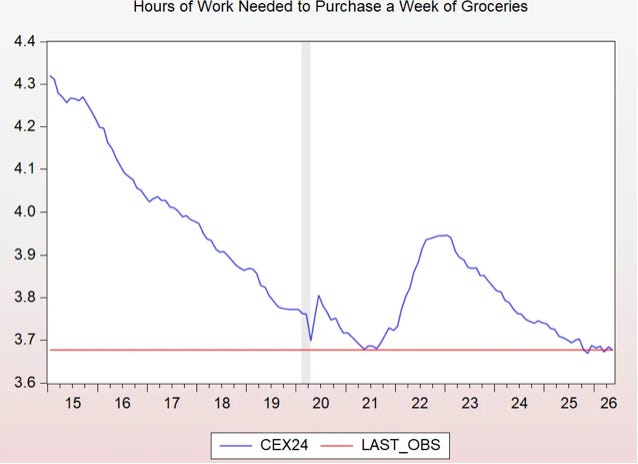
For five years, groceries were costing less compared to wages, and dropping by a lot. Then came the pandemic, and while that number has fluctuated, it has never returned to the downward arc that the metric was on back in 2019, so Americans perceive that as a loss.
And there are plenty of other pressures. “The Iran war has cost Americans roughly $1,000 per household in higher fuel, food and other expenses since the start of the conflict in February,” writes CBS reporter Mary Cunningham, citing an estimate by Moody’s Analytics chief economist Mark Zandi.
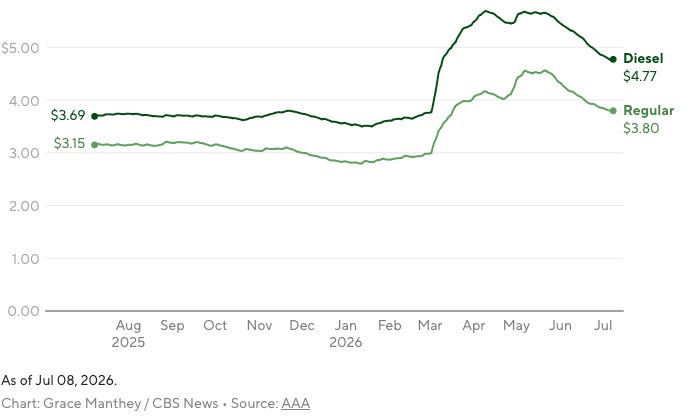
Rising fuel prices are the leading cause of that $1000 price tag, but Zandi also includes increases on the interest rate, jet fuel, and the cost per taxpayer of military actions. Zandi warns that this estimate is likely too conservative, saying that the “true cost is likely higher — meaningfully higher.”
It seems as though we’re entering a new round of bombing in the war on Iran, so you can expect a number of pundits to try to talk down the problem of high prices over the next few weeks. They can spin the numbers all they want, but they’re not going to convince Americans that they’re not being squeezed on virtually every front for every single last penny. Reality hits harder than slick media-friendly spin every time.
Two Years Ago, We Were Building Factories in America. Now We’re Not.
In a post for the Center for Economic Policy and Research, Dean Baker writes that the current presidential administration frequently brags about creating “an unprecedented boom in investment, and especially in factory construction.” Baker continues, explaining that President Trump “constantly talks about the $18 trillion in new investment he has secured for the country, and how everyone is building factories here.”
Baker has crunched the numbers and found that “there is zero evidence of this investment boom to date,” and in fact “factory construction is going the wrong way fast.”
There was a boom in factory construction during the end of the Biden administration due to the big investments found in the IRA and CHIP acts, but since the Trump administration has been actively undoing many of the Biden-era investments in clean energy and infrastructure, those projects have dropped off precipitously since Trump took office in 2025:
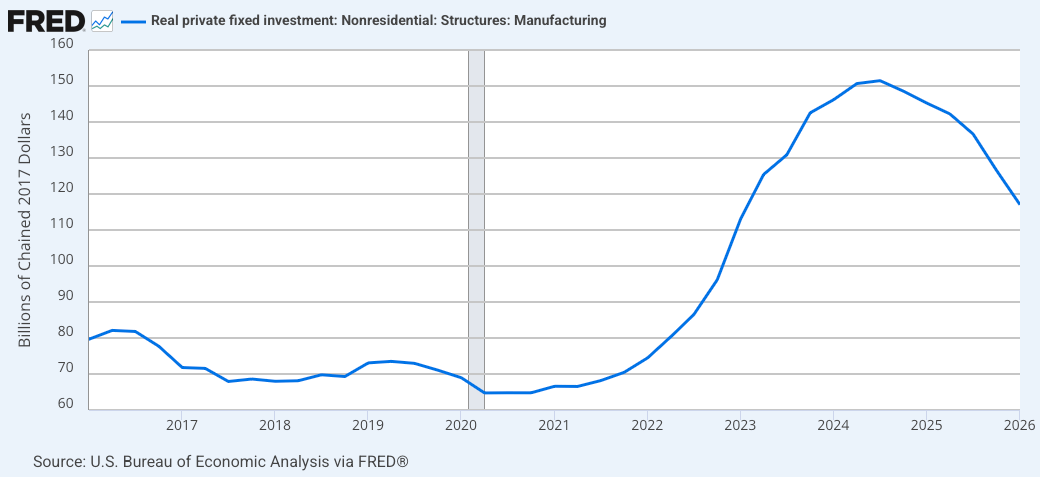
Baker says that factory construction is now about 25% of its peak in 2024.
This is a perfect illustration of the importance of government directing markets. Without incentives to invest in the construction of factories and to develop workforces inside the United States, many corporations will simply choose to build elsewhere. The role of government, through incentives, investments, and regulation, is to direct businesses to where their investments are most needed.
American businesses are brilliant at many things—we lead the world in innovation and productivity—but sustainability is not within their purview. If you want to build something that lasts and benefits the broadest number of people, governments often need to step in.
Here’s another example of businesses choosing short-term profitability over long-term sustainability: Roosevelt Institute economist Mike Madowitz dug into last week’s jobs report and found that despite the desperate need for more housing across the United States, the only growing part of the construction sector is in building AI data centers.
Last month, the American job market lost 2,900 residential building construction workers and gained 3,200 nonresidential building construction workers, and lost 5,700 residential specialty trade contractors while gaining 14,100 nonresidential specialty trade contractors. So of the 11,000 construction jobs added to the economy in last month’s lackluster employment report, a majority of them are probably building data centers that most Americans don’t want, rather than housing that the nation desperately needs.
On a corporation’s balance sheet, the reason for this asymmetry is obvious: Data centers have a lot of money behind them, and it’s money that moves fast. But building an apartment building is a more complex job that moves on a much slower timeline—and the building will take years to pay for itself. If we had huge federal incentives to make the construction of housing more attractive, that would balance out the market and put the power of American business behind something that would be economically beneficial for everyone in the economy.
This Week in Trickle-Down
“The number of students admitted to Ph.D. programs this fall dropped 15 percent from the previous year, according to data from over 50 top research universities, raising fears that the nation’s capacity to produce new science could be diminished,” writes Vimal Patel at the New York Times. “The decline is driven, in part, by a chaotic and unpredictable federal funding environment under the Trump administration, as federal cuts are promised and then reversed, and budgets remain unclear.”
This Week in Middle-Out
A new report from the Washington Center for Equitable Growth finds that making it easier to apply for social support programs helps the working Americans who most need those investments. “In 2012, Virginia moved its application systems for health, nutrition, and cash assistance programs into a single digital platform, which researchers found meaningfully increased participation in social programs,” write Neil Cholli and Derek Wu. “The enrollment portal not only brought new families into program participation, but also helped families already receiving benefits from one program to add others for which they were eligible but had been missing.”
Here’s some good news from Aurelia Glass at the Center for American Progress: “Last month, the U.S. House of Representatives passed the Faster Labor Contracts Act (FLCA), which would require contract negotiations with new unions to go to arbitration if an agreement cannot be reached within 90 days. The bill’s bipartisan passage demonstrates real interest from policymakers in improving labor law, and evidence from a study of Canadian provinces that implemented similar laws suggests those changes increased unionization rates by 2 percentage points.” Even though it’s unlikely that the bill will pass through the Senate, this is a good first step toward making it easier for workers to unionize, and hopefully that bipartisan group of lawmakers can continue to find new ways to advance laws like these.
Real-Time Economic Analysis from Civic Ventures
As part of the summer “Myths That Built Trickle-Down Economics” series on the Pitchfork Economics podcast, we’re revisiting a lively conversation that Nick and Goldy had with Nobel Prize-winning economist Paul Krugman about his book on the zombie economic theories that just refuse to die.
Closing Thoughts
People often find economics to be challenging because the field is so broad. As a topic, economics can refer to anything ranging from international trade to the regulation of prediction markets to the minimum wage. But sometimes, economics is as simple as making sure that children have three meals a day.
Something as simple as regular school lunches can have tremendous long-term impacts on children’s lives. The University of Utah collected recent research showing that children who suffer from food insecurity are likely to “score lower on IQ tests” and have “a harder time getting along with others and specifically have lower math and general achievement test scores than their peers who have enough food.” They’re also “more likely to repeat a grade and have issues with their physical and emotional health.”
“Students as young as kindergarten age who have food insecurity have poor reading performance and impaired social skills, and this can persist into the later grades,” the report shows. These impacts can stretch onward through life, resulting in “mood disorders, behavior issues, substance use, and even suicide” for teenagers and adults.
This is not a niche issue. The University of Utah reported in 2024 that “18% of children under age 18, more than 13 million kids, live in food-insecure households.”
The good news is that food insecurity is a pretty easy problem to solve: If we improve access to food and make SNAP benefits (the food assistance program formerly known as food stamps) easy to access for parents, we can virtually eliminate it overnight. By making food easy to access and free or affordable, we can improve outcomes for one out of every five children in America—and those kids will grow up to be healthier, happier, and more prosperous adults. It’s a tiny short-term investment in long-term economic growth and happiness. We could also improve these programs to make them easier to access, and also allow pre-prepared meals and hot foods, both of which have been left out of many nutrition assistance programs.
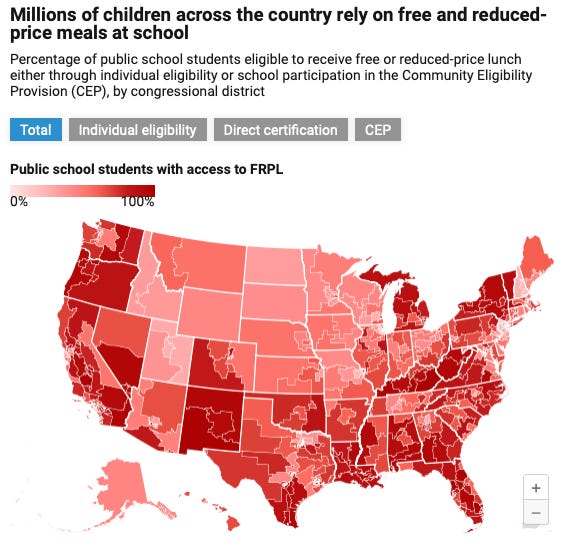
Unfortunately, we’re currently moving backward on childhood nutrition and food assistance. The Center for American Progress released a report this week explaining how the tax bill that the Trump administration pushed through Congress last year, which gave huge tax breaks to the wealthiest Americans and corporations, is slashing access to free and affordable school lunches.
CAP estimates that around 34 million children enrolled in public schools took part in a free or reduced-price lunch program last year. But the Trump tax bill “threatens to eliminate free school meals for students, despite these meals often being their healthiest option, by making cuts to SNAP and Medicaid and putting states in difficult financial positions that may force them to make tough budget decisions that further limit access to food.”
Since the tax bill passed last year, “nearly 4.2 million people lost SNAP benefits by February 2026 following the implementation of more burdensome paperwork requirements and stricter eligibility restrictions,” CAP notes.
Over and above that 4.2 million people being yanked off SNAP rolls, “beginning in October 2026, states will be required to cover 75 percent of SNAP administrative costs—up from 50 percent—and by October 2027, will also assume 5 percent to 15 percent of benefit costs,” CAP notes.
Kids whose families aren’t eligible for SNAP or Medicaid anymore will potentially lose certification for free or reduced-price school lunches, meaning the one guaranteed hot, nutritious meal they get every weekday will be thrown into question. And many school districts are in danger of losing school lunch funding altogether: “If a school or district drops below 25 percent of its student population directly certified, it loses eligibility” for the Community Eligibility Provision, CAP explains, which would remove ”access to free school meals from an entire school or district and [reduce] federal meal reimbursements to schools.”
That adds even more expenses for cash-strapped families: “CAP estimates that a family with two children in public school will spend an additional $1,170 on school-offered lunch and $720 on school-offered breakfast, totaling $1,890 per school year, or more than $2,214 on packed meals.” For many impoverished families, that additional two-thousand-dollars-plus is a cost that they won’t be able to afford, so the kids will either go hungry or eat less than they should.
There is bipartisan support to, at the very least, delay this push of SNAP and other nutrition assistance programs onto the states. For First Focus, economic security expert Chad Bolt writes that “the Republican and Democratic governors of all 50 states have come together to ask Congress to delay implementation of these changes.”
In a statement, the governors warned that “These impacts cut across states of all sizes and political affiliations and, if applied based on disrupted data, risk undermining ongoing investments in program integrity and ultimately the viability of the program.”
Bolt and the governors urge Congress to stall the cuts in state SNAP funding by writing a delay into the next farm funding bill that the Senate will consider this fall, presumably before current agricultural funding ends on September 30th of this year.
Obviously, we need to do much more to ensure that no child in America goes hungry. But for now, there is broad bipartisan support to at least temporarily undo the drastic cuts to child nutrition that were enacted by Trump’s tax bill. If Congress agrees to stall the cuts to SNAP, that would be an opportunity to transform that bipartisan support into a stronger push to improve child nutrition. We can do this by reminding leaders that feeding children isn’t just a moral imperative—it makes good economic sense, too.
Be kind. Stay strong.
Zach