
Not Working for Working Americans
The Pitch: Economic Update for Thursday, August 13th, 2026

Friends,
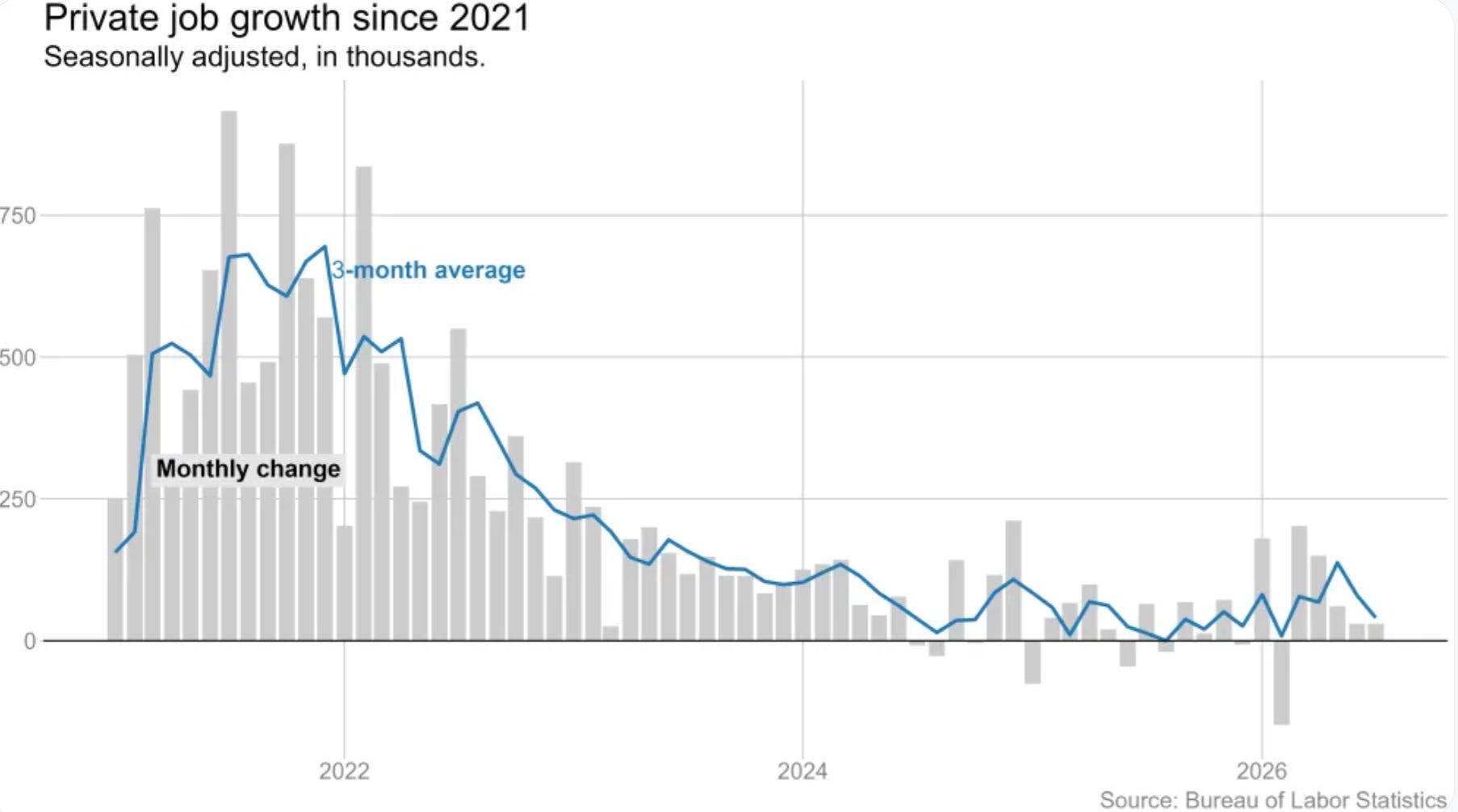
Since the spring, economists have argued that the labor market was at best holding steady and at worst slowly losing steam. That argument fell apart on Friday, when we saw the July jobs numbers: “Employers cut 23,000 positions on a seasonally adjusted basis last month,” Lydia DePillis writes for the New York Times.
Ben Casselman explains that “The July drop was partly driven by a big decline in public school employment, which could be a quirk of seasonal adjustment. But private-sector job growth has also slowed to a crawl,” he warns. DePillis adds, “the unemployment rate dropped slightly to 4.1 percent as hundreds of thousands of people left the labor force.”
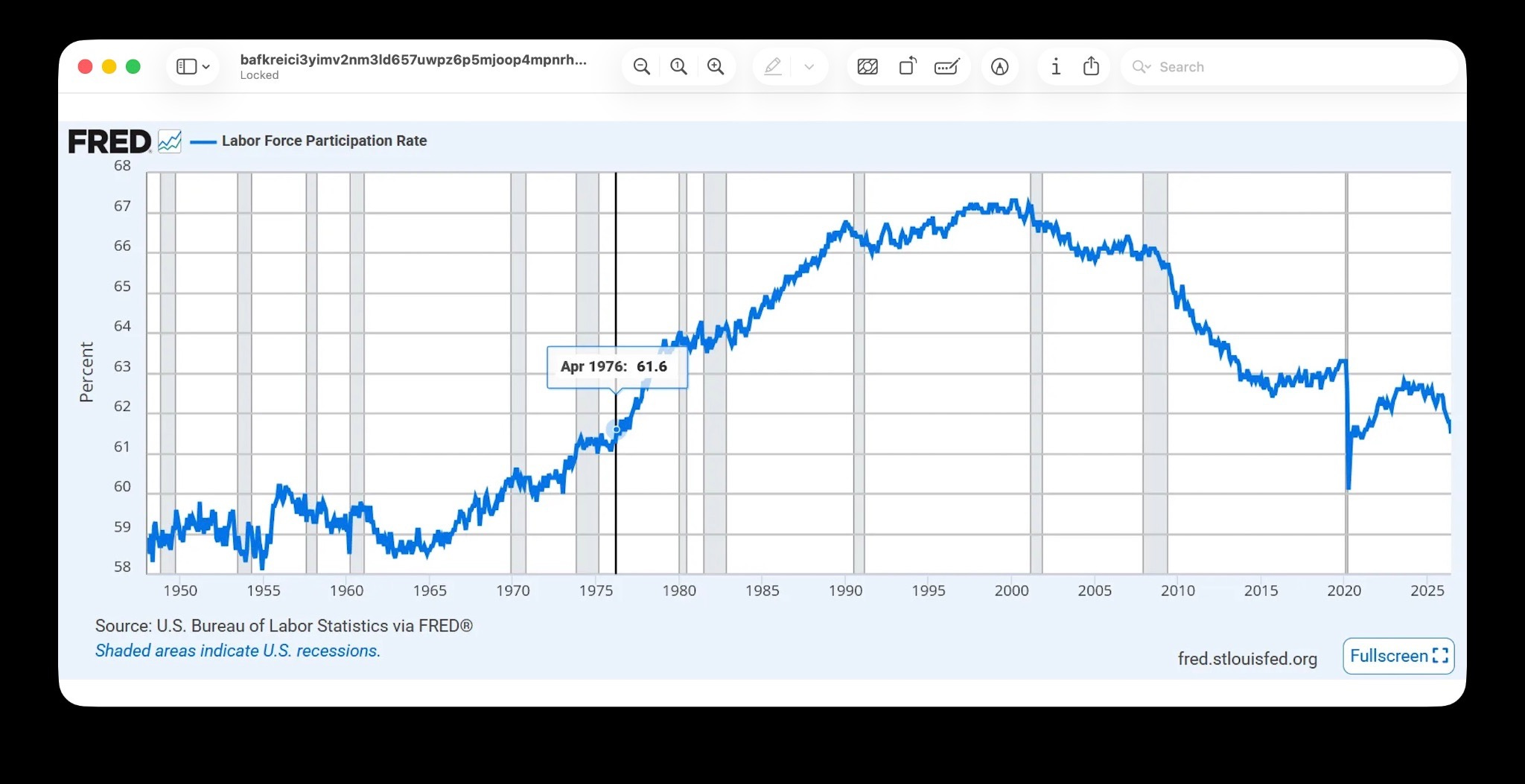
The number of workers leaving the workforce is especially concerning. Aaron Sojourner reports that if you leave out Covid, July’s 61.4% workforce participation rate—meaning the total percentage of working-age people who are holding jobs—is the lowest it’s been in over 50 years. Nearly 40% of working-age Americans are unemployed and currently not looking for work.
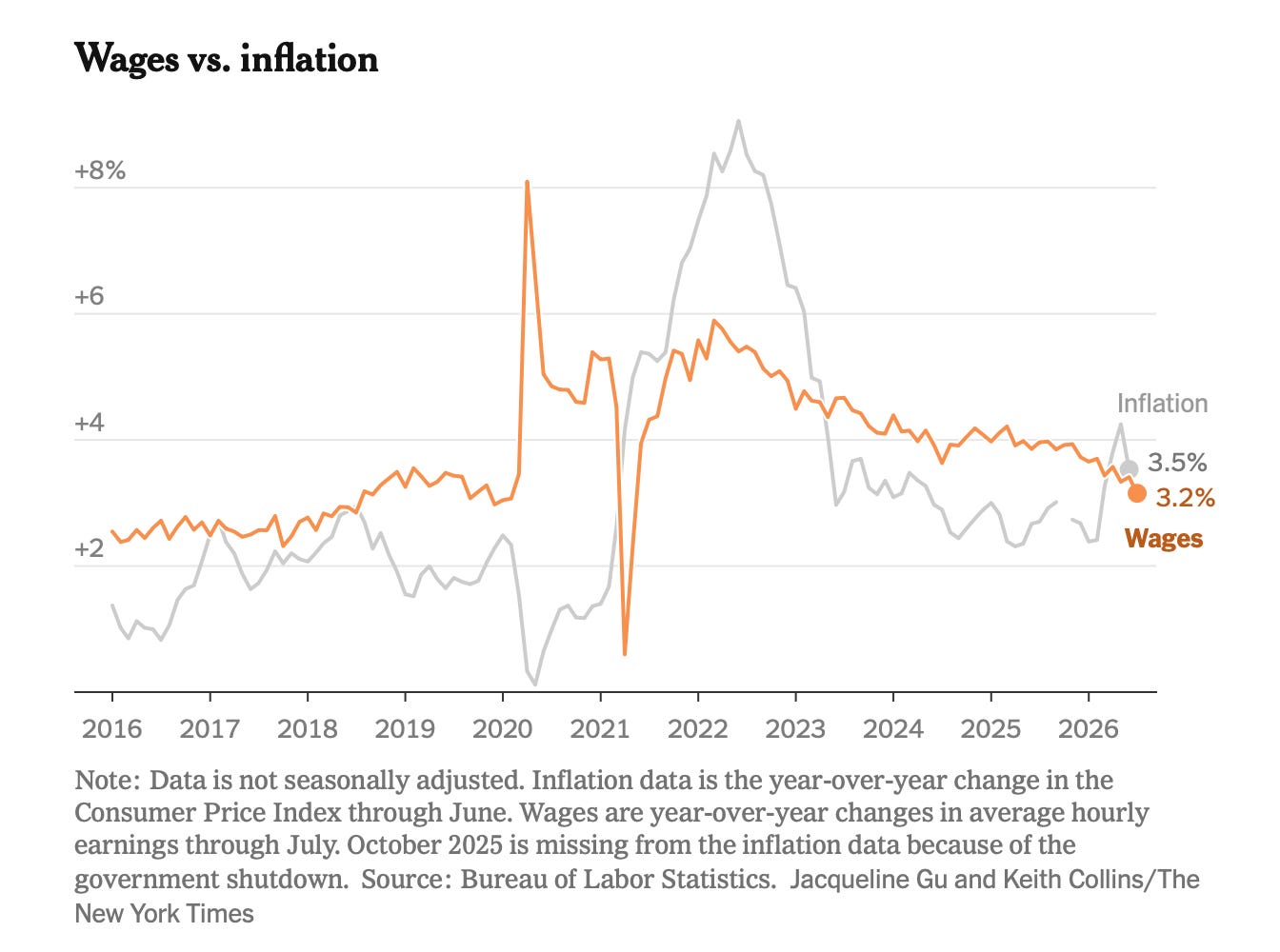
Americans who do have jobs are bringing home less in their paychecks. “Hourly earnings grew 3.2 percent over the year, the slowest pace since May 2021,” DePillis writes.
The stronger-than-expected job gains that the Labor Department reported in May and June, which buoyed many economists’ hopes for a positive turn in the labor market this fall, turned out to be a mirage. May’s addition of 129,000 jobs was revised down to 53,000 jobs in this month’s report, and June’s 57,000 jobs created actually turned out to be 20,000 jobs.
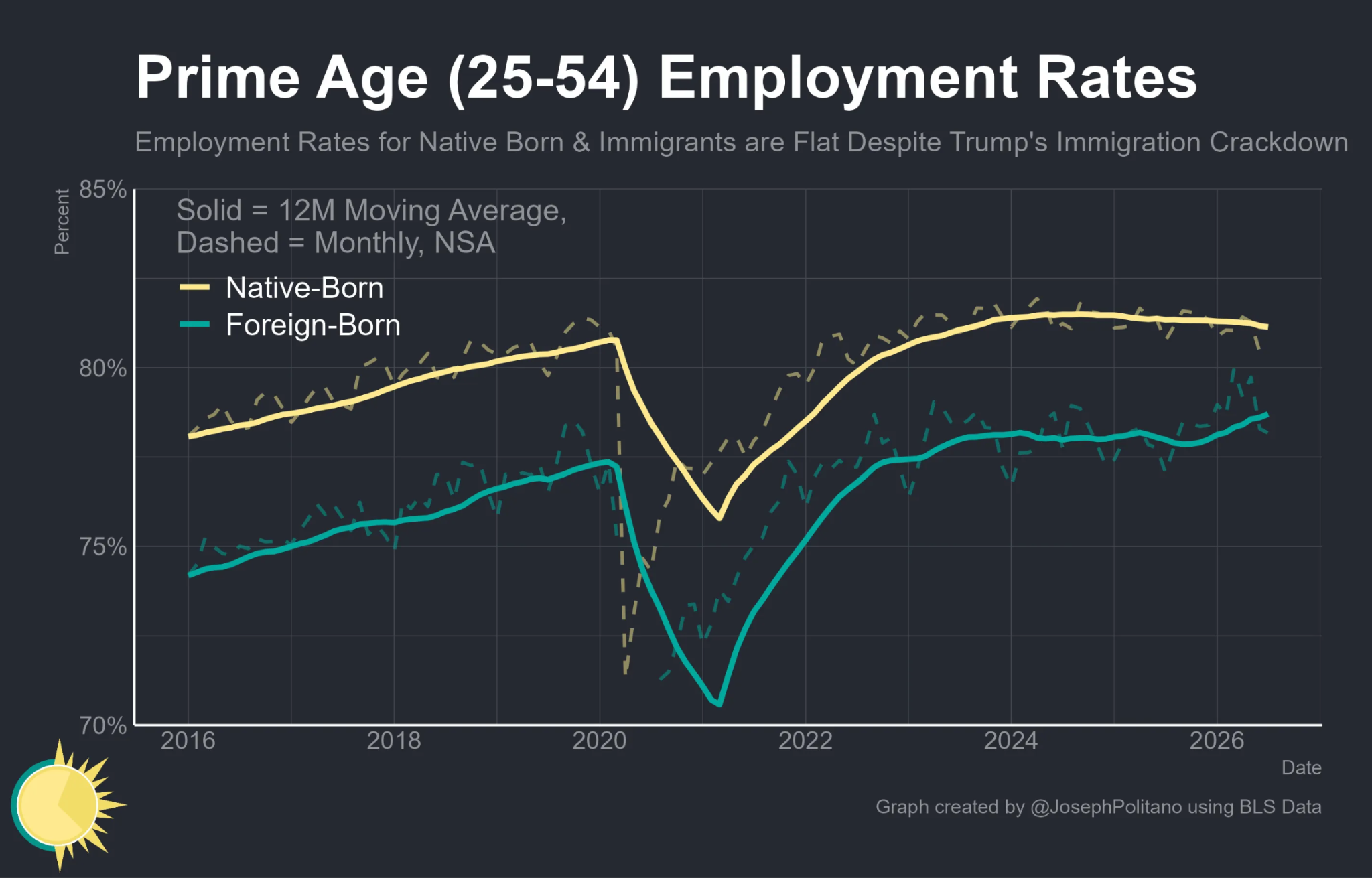
The jobs report looked even worse when you started to look at the underlying numbers. Joey Politano pointed out that despite the Trump administration’s claims that forced deportations of immigrants would create job opportunities for native-born Americans, “prime-age employment rates for native-born Americans fell to the lowest levels in more than four years.”
Virtually every economist predicted that the job market in restaurants and hospitality would boom this summer as tourists arrived for the World Cup. Those jobs never materialized as predicted: America actually lost 12,100 restaurant jobs in June and 26,100 in July
So the toplines of Friday’s jobs report delivered bad news for American workers, and the smaller details of the report delivered even worse news. And in the bigger picture, we can see exactly how much workers have lost throughout the entire trickle-down era. Axios reports that U.S. labor share has reached an all-time low.
“The labor share tells you what percentage of the giant paycheck produced by the U.S. economy goes to workers in the form of wages and benefits, rather than to corporate profits, dividends, rents and interest paid to other economic actors,” reports Matt Phillips.
After decades of deterioration throughout the dawn of the trickle-down era, workers lost more and more wealth to the rich and powerful throughout the 21st century—and now labor share has been plummeting since a brief post-pandemic upswing.
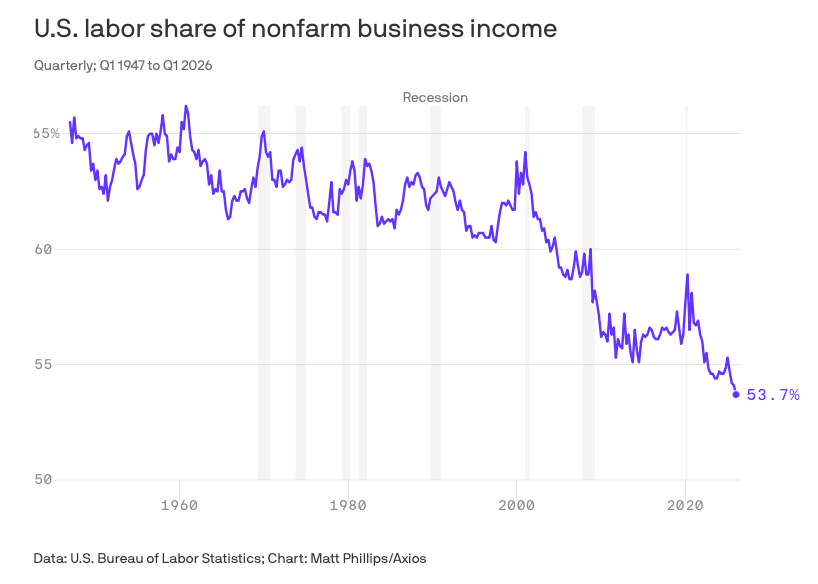
That share is now the lowest ever recorded—53.7%, down more than 10% from when economists began measuring the labor share after World War II. The deal for all of modern history has been that we all own a piece of the American Dream. This is no longer the case. Working Americans own a shrinking share of our national wealth.
It goes without saying that this is unsustainable. As Civic Ventures founder Nick Hanauer famously said, these are conditions for growing unrest, eventually ending in either a violent rebellion or a police state. The percentage of wealth owned by workers will be one of the most important metrics for measuring the nation’s health in the months and years to come.
The Latest Economic News and Updates
Inflation Slows Down a Bit, but Paychecks Are Falling Way Behind
Yesterday’s Consumer Price Index report almost perfectly aligned with most economists’ expectations. “U.S. consumer prices rose 0.1 percent in July and were up 3.4 percent from a year earlier,” Ben Casselman writes. The so-called “core” price index, which excludes volatile food and energy prices, “were up 0.2 percent month/month and 2.5 percent year/year,” Casselman explains.
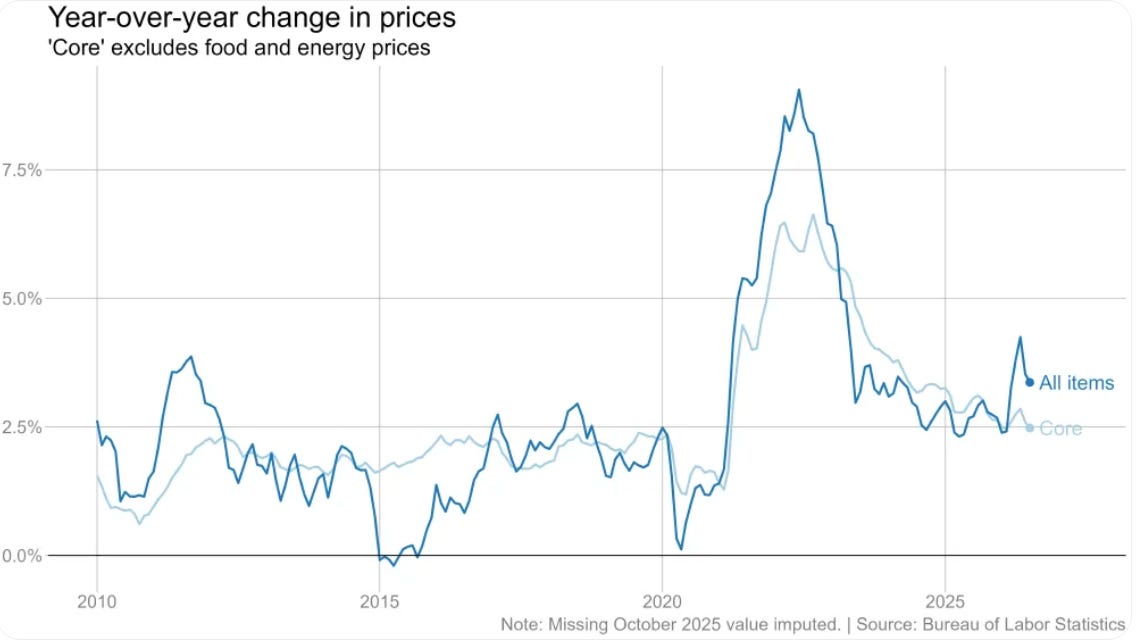
This is a very small step in the right direction—prices are increasing more slowly than they were in the spring, when uncertainty surrounding the war on Iran caused oil and fertilizer prices to skyrocket. But this report is hardly a win for the American people.
While many economists and the Federal Reserve are excited to see core inflation match some recent lows, we need to remember that core inflation is probably the least important metric in the CPI report for working Americans. Remember, core inflation strips out energy and food prices because those are traditionally volatile. Not including food and energy makes sense for professionals who need to chart the overall course of how inflation is trending over time.
For the American people, though, high energy and grocery prices are the whole ballgame—in conjunction with housing prices, they are the top three pricing pressures that families are facing every single month. And food and energy prices are still near the high-water mark of the past three years. Anyone who celebrates this week’s inflation report needs to take a step out of the academic bubble and talk to real people at gas stations and grocery stores to gain some perspective on what all these numbers actually mean.
Another number that was released by the Bureau of Labor Statistics yesterday offers more bad news for Americans: “Real average hourly earnings for all employees decreased 0.1 percent from June to July, seasonally adjusted,” the bureau reported. “This result stems from an increase of 0.1 percent in average hourly earnings combined with an increase of 0.1 percent in the Consumer Price Index for All Urban Consumers (CPI-U).”
So the typical American paycheck stayed flat, but because prices increased last month the spending power of those paychecks fell—not just for groceries or energy, but for everything.
Virtually everywhere you look at consumer data, you can see that workers’ wallets are straining. The New York Federal Reserve issued a report this week showing that debt held by Americans has grown: “Non-housing debt balances grew by $48 billion, or 0.9%,” from the first three months of the year, the New York Fed notes.
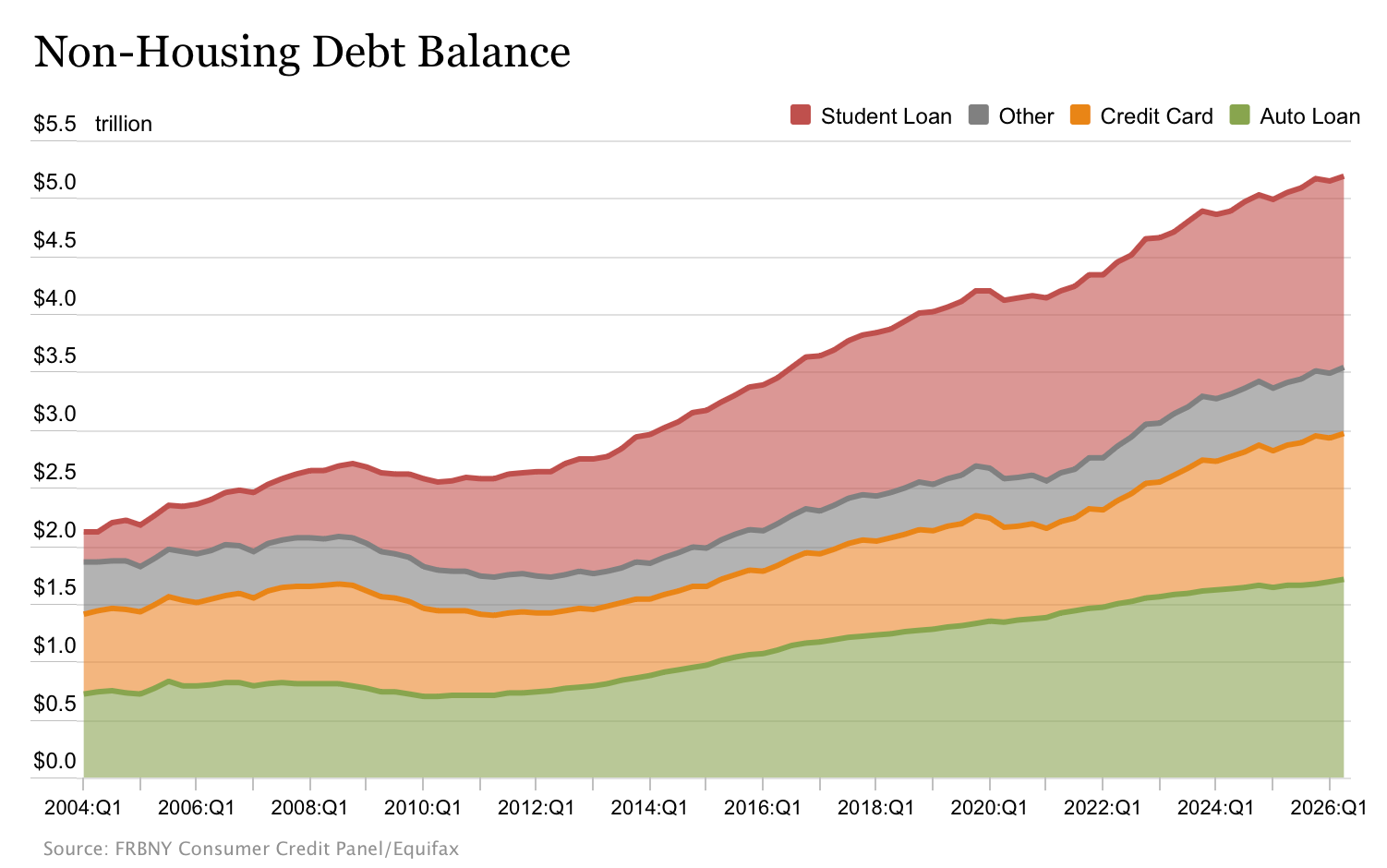
Aside from improvement in student loan debt balances, the rest of the report shows debt continues to grow: “Auto loan balances rose by $28 billion (1.7%), and credit card balances increased by $21 billion (1.7%). Other balances, which include retail cards and consumer finance loans, edged up by $6 billion to $568 billion.” Marketplace notes that “More people are delinquent on their credit card payments now than at any other point since the Great Recession.”
The most positive signal in the New York Fed report is that mortgage balances declined by $74 billion over the last three months. But that number might be decreasing because nobody can afford to buy homes.
“Sales of previously occupied U.S. homes slowed again in July as record prices and the highest mortgage rates in a year prove to be an insurmountable hurdle for many prospective buyers,” reports the Associated Press, which adds that “Existing home sales fell 1.7% last month from June.”
Sales likely dipped in part because “Home prices continued to rise, hitting unprecedented levels for the month of July,” the AP notes. “The U.S. median sales price increased 2% from a year earlier, to $434,100.”
“In June, the median sales price hit $442,800, an all-time high for any single month on data going back to 1999,” continuing a streak of 37 consecutive months of home price increases. With the spending power of paychecks declining, it’s hard to see how that number turns around without major policy interventions that make housing more affordable for working Americans.
Fighting Price Gouging and Growing Paychecks in American Cities
It’s been a rough week in terms of economic data, so let’s turn our attention to some much-needed good news. State and city leaders from coast to coast are promoting policies that seek to bring down costs and grow paychecks for workers. I wanted to highlight two interesting policies that are now being debated in major cities—policies which, if passed, could soon be adopted in other parts of the country.
In my home city of Seattle, Mayor Katie Wilson joined with city councilmembers to put forth a new policy that would make Seattle the first city in the nation to address algorithmic discounts, also known as “surveillance pricing,” through which grocery stores use your personal data to raise the prices of specific items just for you.
The mayor’s office explains that the Fair and Transparent Pricing policy “will bar large online and brick-and-mortar grocery retailers from using sensitive personal information such as employment status, race, gender, social media posts, browsing history, chatbot conversations, or other similar data to set different prices for different customers.”
The law demands that “Prices must be clearly posted and publicly available,” and carveouts will still exist for “Conventional coupons and discounts for seniors, veterans, and other similar groups,” along with “other types of open and transparent discounts.” In other words, coupons, senior discounts, and grocery store club card discounts will still function as they always have, but those discounts must be transparent and broadly available to everyone who meets the standards.
You might remember that last year, Consumer Reports and Groundwork Collaborative found that Seattle grocery stores were charging Instacart shoppers different prices for the same products, indicating that the AI-powered algorithms were likely using the personal information of shoppers to jack up the prices. (Nick and Paul talked with Groundwork Executive Director Lindsay Owens about this report on the Pitchfork Economics podcast.) This law would ensure that grocers wouldn’t be able to use cutting-edge surveillance technology to squeeze an extra few bucks out of you every time you shop, just because you posted about the promotion you earned at work on social media.
And in New York City, Mayor Zohran Mamdani is promoting legislation that would stop big employers from misclassifying delivery employees as subcontractors.
“Major corporations like Amazon have built billion-dollar businesses on a subcontracting system designed to shield them from responsibility,” the mayor’s office writes. “Through delivery subcontractors, corporations dictate hiring standards, delivery routes, steep productivity quotas and workplace expectations while denying that the workers making those deliveries are employees.”
The Delivery Protection Act would establish “a licensing system for certain last-mile warehouses and distribution facilities while establishing new safety, training and labor standards.” In addition, it would “hold the company operating the facility, such as Amazon, responsible for employing the workers performing core services, such as delivery.”
The subcontracting arrangement in so-called “last-mile” delivery facilities allows large employers to avoid responsibility for unsafe working conditions, wage theft, and other workplace safety and worker rights regulations. The mayor’s office points out that unrealistic work performance expectations result in unsafe conditions for everyone else: “78% of nearby areas experienced an increase in injury-causing crashes after last-mile facilities opened,” because drivers under intense quota demands felt pressure to drive over the speed limit and ignore traffic safety laws.
In general, eliminating contractor and subcontractor status is a win-win for workers. Contractors and subcontractors earn thousands of dollars less per year than regular workers, they’re typically not eligible for benefits, and they’re often not protected by the same regulations as typical workers. This policy would immediately benefit some of the most exploited workers in New York City, and those workers would immediately have more money to spend in New York City, growing the economy for everyone.
This Week in Trickle-Down
“The average U.S. household has already paid an additional $610 in gasoline and diesel costs since the start of the war in Iran,” reports the Center for American Progress. “Meanwhile, five of the top American and international oil producers alone have brought in a whopping $65.5 billion in profits in the first half of 2026—65 percent higher than in the same period in 2025.” Those five companies have more than doubled their quarterly profits over last year, CAP notes, “including Chevron, which nearly quadrupled profits.”
This Week in Middle-Out
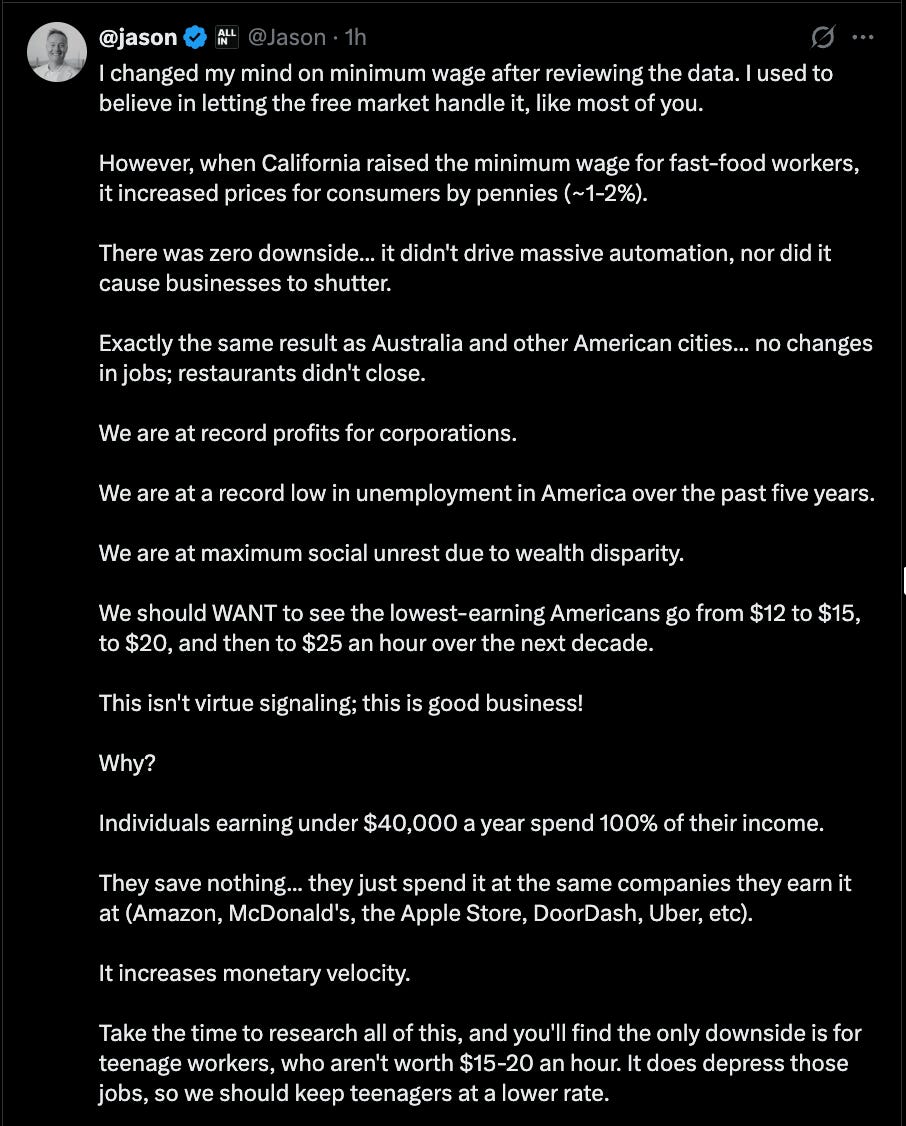
Jason Calacanis, an investor and co-host of the Silicon Valley-friendly All In podcast, has written a mea culpa on raising the minimum wage that should be a must-read for all minimum-wage opponents. I can quibble on some of Calacanis’s points, but it’s refreshing to see someone—especially a public figure—look at the data with clear eyes and come away with an opinion that is the opposite of what they believed for years.
Real-Time Economic Analysis from Civic Ventures
Nobel Prize-winning economist Daron Acemoglu joins Nick and Goldy on the Pitchfork Economics podcast this week to talk about his latest book, What Happened to Liberal Democracy? They discuss why growing wealth inequality has resulted in widespread distrust in democracy around the world.
And on his YouTube channel, Nick Hanauer explains why the fuss over funding Social Security is overblown. He proposes a simple two-part plan that would fully fund Social Security for generations to come and simultaneously grow the annual paychecks of every worker in America by roughly 6%. This is a fun one:
Closing Thoughts
Last week, Texas Senate candidate James Talarico delivered a remarkable policy address that should be shared far and wide. The speech was noteworthy because it identified one of the central problems in America today, explained the deep roots behind that problem, and offered solutions to the problem in a sweeping bit of storytelling.
This is not the kind of speechwriting that you see very often in American politics anymore. Talarico combined a history lecture with explanatory storytelling to contextualize the real fight that’s going on right now—the battle between the haves and the have-nots. You can watch the speech on YouTube:
Or Talarico’s team provided the full text if you prefer to read speeches. Either way, it’s a speech for the ages.
First, Talarico laid out the problem statement. For most Americans, “It’s too expensive to buy a home,” “It’s too expensive to get married and have kids,” and “It’s too expensive to retire comfortably.”
“People are working hard and playing by the rules,” Talarico explained, “But the ‘rules’ of today weren’t written for us. They were written for billionaires.”
Jeff Bezos, Elon Musk, and Mark Zuckerberg “now own more wealth than the entire middle class,” Talarico said. “The top 1% put the American Dream behind a paywall.”
This is the end result of a real-life plan, he continued. We know it was a real plan because it was written down by a lawyer named Lewis Powell. “The Powell Memo outlined a strategy: unite corporate special interests, privilege corporate perspectives in the media, appoint sympathetic judges to the courts, and buy politicians on both sides of the aisle,” Talarico said, adding, “And it worked.”
Readers of the Pitch know trickle-down economics promises that if you invest in wealthy people and corporations by slashing taxes on the rich and deregulating the powerful, the wealth those policies create will eventually trickle down to everyone else. But actually, due to the third leg of the trickle-down stool—lower wages and less worker power—workers’ paychecks have stagnated. Some $80 trillion in cash that used to go to worker paychecks is now airlifted up to the top one percent. As Talarico says, “Trickle-down economics isn’t a theory. It’s theft.” It’s taken from tens of millions of working Americans, and handed to the elites.
All this historical context is nice, but what does it mean for Americans today? What does all this have to do with whether James Talarico wins the Senate seat in Texas?
“This ‘affordability crisis’ isn’t something that happened in the last five years. This affordability crisis has been fifty years in the making,” Talarico said.
That’s an important point. That $36,000 that’s been sucked out of the paychecks of average working Americans would make a lot more things a lot more affordable. “We have an affordability crisis because we have a corruption crisis,” Talarico said. “We’re getting screwed. Whether you’re a little more conservative or a little more progressive — we’re all getting screwed.”
This is not a partisan issue, he explained. Democrats and Republicans have both been in on rigging the system against the vast majority of working Americans. “They see us as people they can rip off. They see us as one opposing team. So we might as well act like one,” he says.
“It’s time for us to come together — across these manufactured divides — and take on the people at the top who have been screwing us over,” Talarico said. “Because the real fight in this country is not left vs. right; it’s top vs. bottom.”
This is perhaps the most straightforward and informative description of how trickle-down economics became the economic operating system of the United States of America that I’ve heard from a politician. It’s a compelling argument that trickle-down is behind most of our problems of inequality and affordability. So what does Talarico say he’s going to do about it?
That’s where the policy solution part of the speech comes in. Highlights include raising the minimum wage and expanding overtime pay, repealing the tax cuts passed by the Trump administration, and making it easier to form a union. He also proposes canceling medical debt, capping credit-card interest rates, expanding the child tax credit, and investing heavily in education, among other policies.
I urge you to listen to or read the whole speech for the full policy agenda. But Talarico explains that all of those policies are in service of three simple goals that hearken back to the beginning of the speech: By stripping trickle-down out of America’s economy, Talarico hopes to create an America where working Americans have access to “A house big enough to raise a family in,” a “quality education for yourself and your kids,” and a “retirement that is comfortable and secure,” as well as more “time doing what you love with the people you love.”
Put another way, his goal is nothing less than the renewal of the American Dream. Is this a tall order for one Senate candidate? For sure. But by making this cogent and powerful case against trickle-down and for investing in working Americans, Talarico is doing the important work of explaining to the American people that they’re not mistaken—the economy really is rigged against them. And he painstakingly explains who did the rigging, who benefits, and how.
Every economy is a story, one that explains who gets what and why. Fifty years ago, Lewis Powell and his associates changed the story to one that benefited the wealthy few at the expense of the many. With this speech, Talarico is doing his part to tell a better story about America. It’s a story that I believe many Americans would be very interested in hearing.
Be kind. Stay strong.
Zach